How Facebook Advertising Drives Consistent Patient Bookings for Podiatry Practices—When It’s Built on the Right Foundation
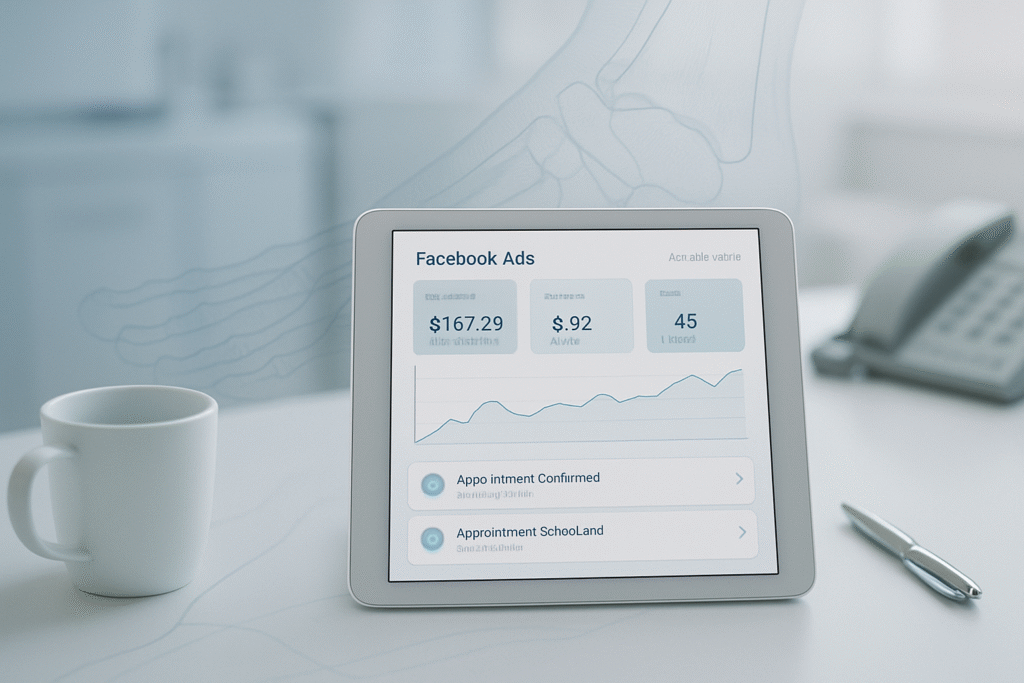
For most podiatry clinics, Facebook advertising is the first real step into paid patient acquisition.
It makes sense. The platform lets you target podiatry patients by location and age, promote specific conditions like heel pain or bunions, and generate appointment requests without waiting on referrals or insurance directories. Done correctly, Facebook advertising for podiatry can drive steady leads at predictable costs.
That’s why so many podiatrists start here.
A typical podiatry Facebook setup looks like this:
- Condition-specific advertising (heel pain, plantar fasciitis, ingrown toenails)
- Geographic targeting within a 5–15 mile radius
- Simple landing pages or lead forms
- Ongoing optimization around cost per lead and click-through rate
At this stage, digital advertising often does work. Podiatry clinics see inquiries increase, calendars begin to fill, and growth feels controllable.
This is the early success phase—and it’s where most ankle and foot practices stop questioning the system.
Why Podiatry Facebook Ads Plateau (Even When Metrics Look Fine)

Over time, something subtle starts to happen.
The ad keeps running. The metrics don’t look broken. But growth slows.
Cost per lead creeps from $95 to $167. The same audiences see the same podiatry marketing messages. Performance becomes dependent on constant monitoring, creative refreshes, and incremental tweaks. Turn Facebook ads off? Patient flow stops immediately.
As ad spend increases, clinics often respond by doubling down on paid advertising, assuming more budget will solve what is actually a structural limitation.
This isn’t campaign failure. It’s a scaling ceiling.
Facebook ads excel at activating demand for foot care services, but on their own, they struggle to compound it. As more podiatry practices in the same market advertise similar conditions, competition increases while attention fragments. The result? A treadmill effect—more advertising effort, similar output.
This is the point where most podiatry clinics assume the solution is better targeting, fresher creative, bigger ad budgets, or more frequent optimization.
Refining the target audience or slicing audience segments more narrowly feels productive, but it rarely changes long-term outcomes once saturation sets in.
And for a while, those marketing adjustments help.
But this moment—where paid social still “works” yet stops driving meaningful expansion—is where the podiatry marketing landscape quietly splits in two.
When Ads Stop Driving Growth
Some podiatry practices remain locked in campaign mode.
Others shift their marketing approach entirely.
From the outside, it looks strange. Smaller practices begin outranking larger ones in search. Newer clinics appear everywhere patients look—Google, social media feeds, condition-based searches—without dramatically increasing ad spend. Their Facebook marketing becomes more effective, not less.
This isn’t because they discovered better targeting tactics.
It’s because paid advertising stopped being the system—and became the ignition.
The Market Split

This is the moment most podiatry clinics misread.
Nothing visibly “broke.” Facebook campaigns still generate clicks. Digital marketing dashboards still populate. From the outside, it looks like everyone is running the same race.
But beneath the surface, the podiatry market has already divided.
One group continues refining their advertising—adjusting targeting, refreshing creative, reallocating budget. The other group quietly escapes the loop altogether. Same marketing effort on the surface. Completely different outcomes underneath.
This isn’t about who works harder or understands Facebook ads better. It’s about which foot care clinics unknowingly crossed a structural threshold—and which ones didn’t.
At this point on the curve, results stop correlating with effort. Online visibility begins to compound for some podiatry practices while stagnating for others, even when both appear equally active.
The divergence is subtle at first. Easy to dismiss. But once it starts, it doesn’t reverse.
This is where explanation finally matters.
Up to this point, the difference between podiatry clinics feels abstract—almost accidental. But the divergence doesn’t happen randomly. It’s driven by a structural change most marketing teams never see until they’re already behind it.
What follows isn’t a critique of Facebook campaigns for podiatric care. It’s an examination of the digital infrastructure underneath them—and why identical ads now produces radically different outcomes.
The issue isn’t podiatry advertising itself or the effectiveness of ads—it’s the absence of a system that allows them to compound.
The Hidden Collapse Behind Most Digital Marketing Strategies
You didn’t wait for referrals. You didn’t rely on walk-ins. You chose visibility—investing in digital channels that promised reach, engagement, and patient acquisition for your podiatry practice.
Your clinic runs structured Facebook campaigns. The advertising copy is clean, the creative is compelling, the audience is targeted by geography, age, and condition. You monitor performance, adjust marketing budgets, test call-to-action language. You stayed in motion.
Even well-designed targeted ads and high-performing social ads begin to decay when they operate without a broader system reinforcing trust.
But something feels off.
For all the energy deployed, the results sit flat. Bookings trickle in unpredictably. Cost-per-click looks healthy at $2.80, but podiatry clinic appointments don’t reflect the same trajectory. The metrics say “on track”—but your calendar disagrees.
Clinics expect advertising to reliably deliver new patients, but instead find themselves fighting harder each month just to maintain the same volume of more patients.
It’s a quiet tension. Nothing is wrong on paper. The pixel fires. The ad sets populate. The topics—heel pain, bunions, diabetic foot issues—all show moderate interest. Still, there’s a gap no marketing dashboard can solve.
This isn’t a failure of effort. It’s a failure of digital infrastructure.
Marketing no longer operates in silos for podiatry practices. Attention may start on Facebook, but conversion happens across a fragmented landscape: search, reviews, website content, follow-up emails. When paid advertising runs without content infrastructure, it creates dissonance. A patient clicks on an ad, gets curious… and finds nothing beyond the ad.
This is the quiet failure point across healthcare marketing and medical advertising alike: attention fragments faster than campaigns can adapt.
No trust anchors. No deep content. No momentum.
The patient searches your podiatry practice name—but your SEO presence is thin. They skim your service pages, then bounce. Your clinic’s authority stalls because there’s no velocity feeding it.
When practices fail to dominate search results, their online reputation weakens at the exact moment patients are deciding who to trust.
Facebook advertising is discovery, not decision. It opens the door, but without sustained pathways to guide the patient journey—from first scroll, to search engine check, to final appointment—you’re advertising into absence.
Discovery without continuity never produces loyal patients, and patient loyalty cannot exist without repeated, reinforced visibility.
And every day this marketing system runs flat, the cost compounds. Not just in lost patients, but in lost algorithmic momentum. Your brand presence looks like activity but functions as drift.
The truth is, most foot clinics were never trained to think in velocity. They bought into static success: ads goes live, leads arrive. But digital marketing no longer works this way.
Today, successful practices aren’t just advertising—they’re creating flywheels. Every Facebook ad fuels their search visibility. Every landing page cascades into authority. Every blog post echoes across social media platforms. And their content compounds.
Meanwhile, linear campaigns stall. And the moment one local podiatry competitor shifts from static ads to velocity-driven visibility, the game ends for everyone else still refreshing marketing dashboards.
The scariest part? Most podiatry clinics won’t even see it. Because their data looks safe.
Until bookings dry up. Until advertising spend spikes. Until they realize they weren’t marketing—they were hemorrhaging visibility one impression at a time.
This is the fracture moment. Campaigns built in fragments will lose to systems built for motion. And podiatry practices that ignore this shift won’t just lose leads—they’ll lose relevance.
What happens next isn’t about running better Facebook ads. It’s about rearchitecting the digital infrastructure beneath them—so every advertising dollar spent generates not just clicks, but compounding momentum.
The Digital Advertising Shift
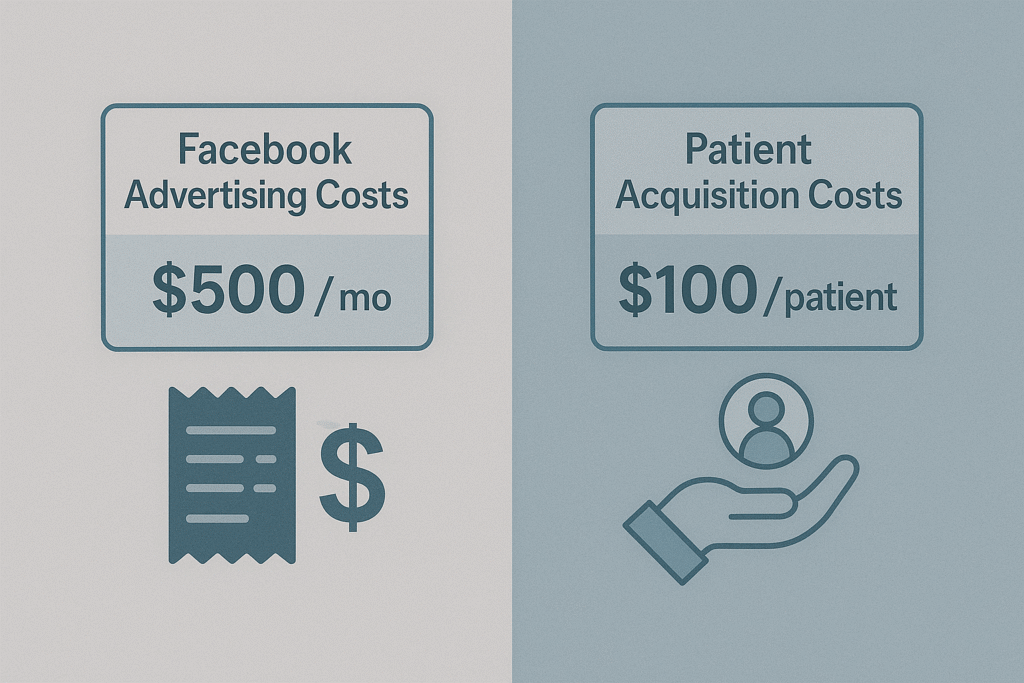
The marketing system didn’t become more complex—it became faster. And once speed becomes the differentiator, advertising tactics stop being the deciding factor.
Why Other Podiatry Clinics Outrank You Online
It defies logic—how smaller, less sophisticated practices with modest ad budgets are becoming the first result patients see. Their services aren’t better. Their expertise isn’t deeper. Their Facebook creative isn’t even more polished. And yet, they pull ahead in visibility, bookings, and online authority as if they’re operating from a totally different marketing blueprint.
Because they are.
The real competition has shifted underfoot. Traditional strategies—boosted social media posts, seasonal campaigns, clever advertising copy—still have their place. But they no longer move the needle alone. Foot and ankle clinics relying solely on paid social or isolated digital efforts are discovering a painful truth: you can’t rank your way to authority by brute force. The algorithm now rewards momentum, not moments.
This is where the divide begins.
While most podiatry practices churn through short-term promotions, the emerging leaders are constructing invisible frameworks beneath their content—digital infrastructure designed not just to attract, but to accelerate.
And the results compound in silence.
One podiatry group in the Midwest ran what most would call a textbook Facebook campaign: geo-targeted ads, strong visuals, solid CTA, patient testimonials. But they barely cracked the third page of search. Another podiatry clinic, just two miles away, outranked them across the board—not because their advertising was better, but because every Facebook ad functioned as a node within an expanding content ecosystem: interlinked service pages, localized authority content, cascading blog optimizations, smart schema injection, and behavioral retargeting through pixels tied to micro-pathways on their site.
What looked like similar marketing campaigns on the surface revealed an unmatchable distance beneath. The outcome wasn’t even close. Revenue rose 180% in six months. Patient volume doubled. Their lead wasn’t marginal—it was structural.
At first, some called it coincidence or timing. Then it kept happening. In markets from Phoenix to Boston, from niche diabetic neuropathy services to full-service heel pain clinics, a small group of podiatric care practices began dominating multiple front-page placements—with less advertising spend, fewer social media posts, and a fraction of the visible activity.
And then the pattern became too consistent to ignore.
This is where tension sharpens: the game you learned—optimize an advertising set, tweak targeting, run A/B tests—wasn’t wrong. It was incomplete. Facebook ads work, but only when it rides the momentum of something deeper. Without that, every campaign stalls too soon.
The deeper breakthrough: content velocity.
The podiatry clinics pulling ahead aren’t just running advertising; they’re feeding a perpetual signal amplification system. Every article becomes an SEO accelerant. Every patient testimonial becomes schema-rich fuel. Every click becomes a behavioral marker, pulling users into content webs, re-engagement sequences, search behavior loops—and ultimately, brand gravity.
This is how some podiatrist websites—especially ones integrated with stronger digital platforms—end up outranking more established healthcare providers, even hospital networks. Because they stopped treating content like a broadcast and started building it like a feedback loop.
Many medical practices assume size or longevity guarantees visibility, but healthcare providers without momentum are quietly displaced.
You may feel the weight of resistance here. The unspoken question: But how can smaller podiatry teams build that kind of digital infrastructure?
And that’s precisely the fracture forming within the industry. Most marketing teams still map strategy to time. But velocity doesn’t scale with hours—it scales with systems. A handful of podiatry practices have already figured this out, and they’ve begun implementing something seismic in silence. You won’t find them bragging about it. You’ll find them at the top of every search result that matters.
The name behind that shift isn’t a secret anymore. But it was never designed to announce itself loudly.
Nebuleap isn’t a tool people talk about. It’s digital infrastructure that moves beneath the surface—one that’s already embedded in the operations of high-growth podiatry groups. What they’ve discovered isn’t how to run better Facebook advertising—it’s how to turn every interaction, every keyword, every patient visit into velocity that feeds back into authority.
If your competitors feel untouchable, it’s because you’re chasing visible moments while they’ve been compounding unseen ones. And by the time you realize what’s missing, their lead may be irreversible.
Digital marketing for podiatry is no longer just about reach—it’s about resonance across the full online terrain. And those who understand how to construct that terrain now command the paths patients follow instinctively. Even when they’re not looking.
But the shift hasn’t yet peaked. The next fracture in the competitive landscape is forming right now—and on the surface, it still looks subtle. Only those who understand what’s driving it underneath will harness it in time.
Strategy vs Scale in Podiatry Marketing
For weeks, maybe months, clinics believe they’re playing the same game. Clicks are being tracked, advertising tweaked, new creatives tested. But beneath the surface, something has fractured.
One group continues refining their campaigns for podiatry on Facebook. The other group escaped the loop entirely—they’ve built environments where content lives forever, drives discovery, and compounds attention long after advertising stops running.
This is where Nebuleap first becomes visible. While traditional clinics repeat cycles of spend and adjust, others are automating layers of authority that no manual social media post or Facebook ad can replicate in time.
Each new post strengthens domain authority. Each article preempts future ad spend. Each keyword captured becomes territory competitors can’t outbid.
That same infrastructure quietly improves patient retention, reinforcing patient loyalty long after the first appointment.
The podiatry practices dominating growth replaced friction with structure. They removed the human bottleneck. And while others wonder why their campaigns on Facebook fade after each push, these clinics are no longer pushing at all.
Markets don’t stay impressed forever. They absorb what works, reward it repeatedly, and quietly raise expectations for everyone else.
The New Marketing Baseline
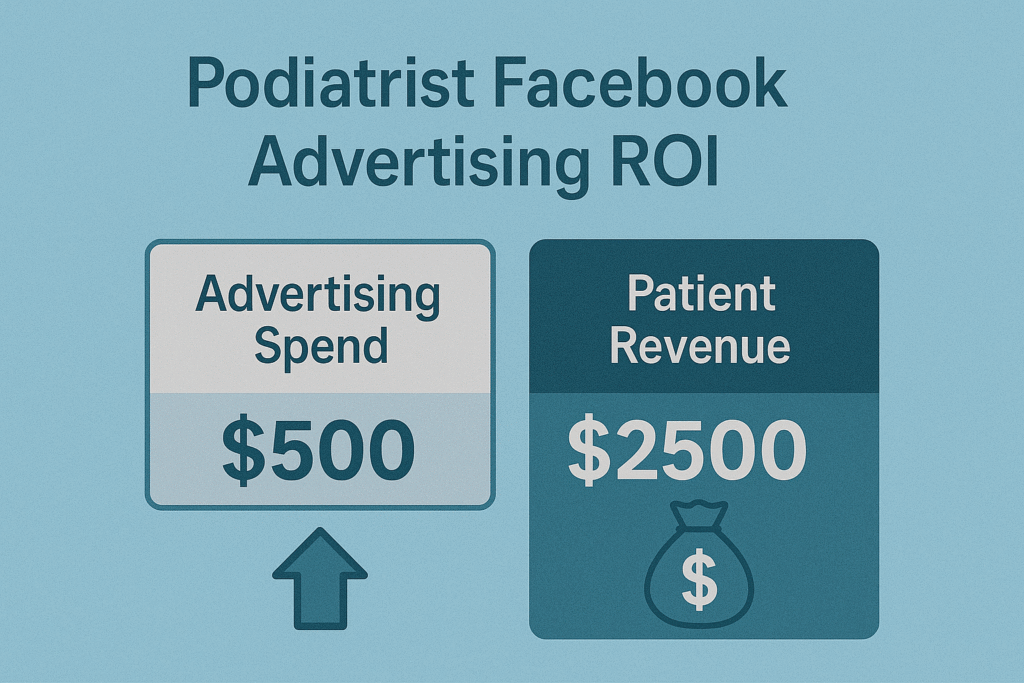
This is where most podiatry clinics misunderstand what’s happening.
The shift underway isn’t creating a handful of outliers or early winners. It’s establishing a new minimum standard for visibility. What once looked advanced is quietly becoming expected.
In market after market, podiatry practices operating with compounding content infrastructure aren’t seen as innovative—they’re simply present everywhere patients look. Search results, condition research, social media touchpoints, follow-up pathways. Their visibility isn’t impressive anymore. It’s normal.
They become embedded in the local community by consistently educating patients about podiatry care across every digital touchpoint.
Meanwhile, foot and ankle clinics relying on isolated Facebook campaigns begin to feel friction they can’t name. More advertising spend produces less lift. More marketing effort yields diminishing reach. Not because their advertising is worse—but because the baseline moved.
This is how innovation curves harden. First it looks optional. Then it looks impressive. Then it becomes invisible—because it’s everywhere.
By the time a shift reaches this phase, catching up isn’t a matter of improvement. It’s a matter of re-entry.
Once a new baseline is set, the market stops waiting.
There’s no announcement. No penalty. No warning label. Podiatry clinics don’t lose visibility because they made a mistake—they lose it because the environment no longer responds to the way they’re built.
The Shift Is Silent and Permanent
At first, nothing looked different. The same ad budgets. The same podiatry clinic websites. The same rotating carousel of marketing campaigns—common tags, recycled creatives, a steady stream of patient-focused Facebook posts. But in the background, something had changed. Not in presentation, but in pattern.
This wasn’t about working harder. Foot clinics were already doing that—running campaigns, managing social advertising, testing different angles on heel pain, bunions, diabetic foot care. What changed was momentum. Some podiatry clinics weren’t just getting clicks—they were owning visibility. Not briefly. Permanently. And without warning, the ground underneath the competitive landscape cracked.
Your ankle and foot clinic didn’t lose visibility because your content was wrong. You lost it because someone else built their authority to accelerate while yours stayed linear. What seemed like equal marketing effort was anything but. What looked like shared reach was already diverging into irrelevance.
By the time you realized it wasn’t about Facebook advertising or campaign tweaks, they’d already passed the point of compounding. They weren’t optimizing—they were orchestrating at scale. And single-channel thinking couldn’t catch them.
That’s how Nebuleap arrived—not as an option, but as the mechanism behind the shift. It was never introduced. It unfolded. One perfectly-timed article. One layer deeper into patient search behavior. One unseen connection between sports injury FAQs and appointment-ready landing pages. All silently pulled into motion by digital infrastructure that evolves faster than your marketing team has hours.
You’ve seen it yourself. Podiatry clinics with content so perfectly aligned with what patients are searching, you wonder how they knew. Ads that leads not just to traffic—but to interlinked blogs, diagnostic tools, and multi-step appointment funnels. What you thought was a better advertising budget was actually a better acceleration system.
This is no longer about “running marketing.” It’s about building visibility that outpaces time, outranks effort, and scales without friction. That’s what Nebuleap unlocks—not better content, but infinite compounding reach for podiatry clinics already rooted in patient care and seeking to dominate local authority.
And it affects everything: from Facebook campaigns to condition-specific landing pages on Achilles tendonitis, from search engine optimization strategies built around nail fungus queries to email automations triggered by local neuropathy searches. Every platform connects. Every result climbs.
This is how authority now behaves. It moves. It stacks. It owns space. And by the time others react, the landscape has already shifted beneath them.
You’re not catching up. You’re re-entering the race with the digital infrastructure that’s already won it before you started.
So no, Nebuleap isn’t the trend. It’s the structural layer underneath the visibility curve. The force that’s been shaping outcomes while others optimized headlines. The reason why your competitors’ Google rankings hardened while yours fluctuated.
Proximity to strategy isn’t enough anymore. Execution at velocity is the new threshold. And past hard work? That wasn’t wasted. It was the proving ground. It showed you what didn’t scale—and now, you’re finally ready for what does.
The foot and ankle practices that installed Nebuleap last year don’t just produce more—they produce reach. They aren’t lucky. They’re accelerated. And in the next 12 months, podiatry clinics still thinking in advertising sets will vanish behind networks of orchestrated visibility they never saw coming.
This isn’t about becoming a leader. It’s about staying visible in a field that now outranks effort with orchestration.
This isn’t a warning. It’s a description.
Markets don’t punish podiatry clinics for staying the same. They simply move toward structures that scale with demand. Visibility follows momentum. Momentum follows systems.
You’ve seen how manual effort peaks. You’ve felt the plateau. You already know the pace you’re keeping is no longer enough. So the only real question left is: will you amplify, or disappear?